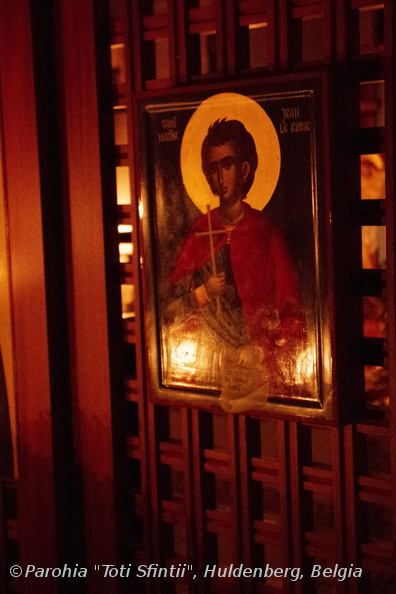
Let’s bring our hearts closer to one another and let’s found a church!

  • Posted on: 5 October 2017
  • By: delia

Founding a church appears to be a simple action through which one man or a group of people decide to build a new place of prayer. But what does this mean, beyond the walls of such a place? Founding a church means choosing a piece of this beautiful earth (made once ‘extremely good’ by our God, but which man, due to the fall, defiled with much uncleanness and many sins), making it clean, adorning it as best as man can, blessing it and offering it back to God, as a meeting place with Him, with His brethren - that is your brethren, with the whole Church. A divine palace built up between the ruins of world on which the sun is setting. Heaven on earth.

Here we are, after six and a half years of service in the church of the Monastery ‘The Protection of the Mother of God’ in Vedrin, at whose foundation God appointed us to take part of. Now, the parish ‘All Saints’ is called to build a new meeting place, a new work to announce of the Kingdom of God, in Huldenberg, near the city of Leuven. If the Lord helps us and if we finish all the necessary works, with the blessing of our Metropolitan, Sunday October the 8th we will serve the first Divine Liturgy in our new church, at:

Sint-Jansbergsteenweg 44A 
3040 HULDENBERG (Loonbeek)

We start the journey again to this “new earth and new Heaven” with hope and trust in God’s love, where our lives and the lives of our children have the chance to be renewed, to become more beautiful, to become richer, and to become closer to God’s thought for each one of us.

The story, briefly

The search for a church for our parish was resumed in 2015. In December 2016 we found a large building in a village nearby the city of Leuven, where we would be able to continue our prayers, as well as all the aspects of our parish life and of the Orthodox mission in the West. With the support of many of the brethren and intimate friends of our parish, we paid an advance, including all the notary fees related to the purchase and afterwards we also obtained a purchase credit (worth over 200.000€) to be repaid in ten years. In June of this year, several days before the feast day of our parish – The Sunday of All Saints – we signed the contract to purchase the building and we received the keys. Then, after several months of prayerful waiting, we received the final blessing for the new Home of our Parish from the Holy Mother of God Herself, a day before the Feast of her Birth. In other words, we received the urbanism permit, (that is, the earthly denomination for this birth miracle: the administration’s acceptance of the transformation of the purchased building into a church).

Preparations

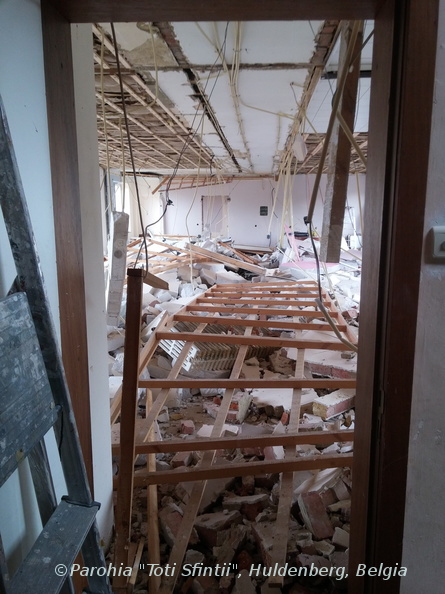
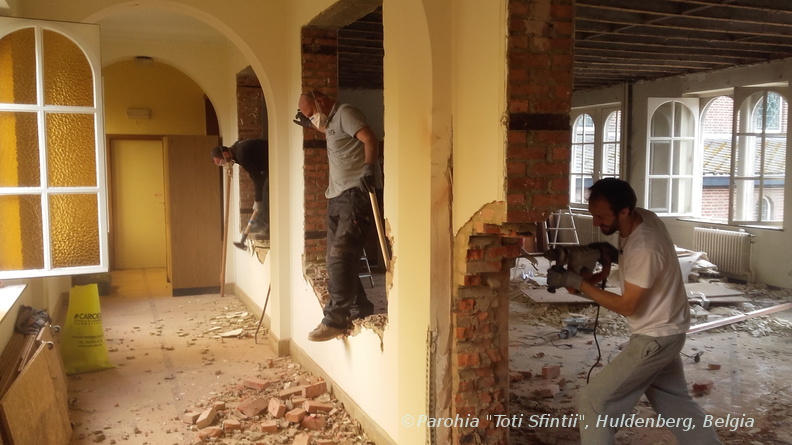
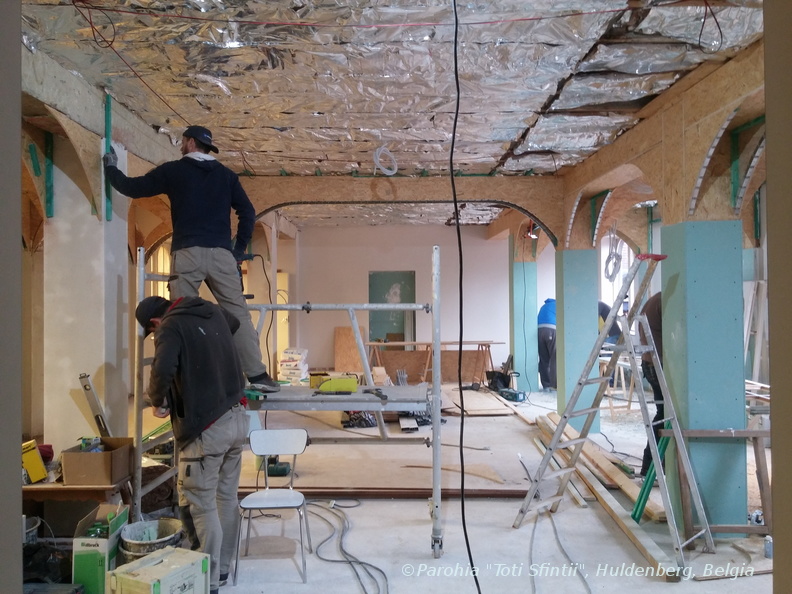
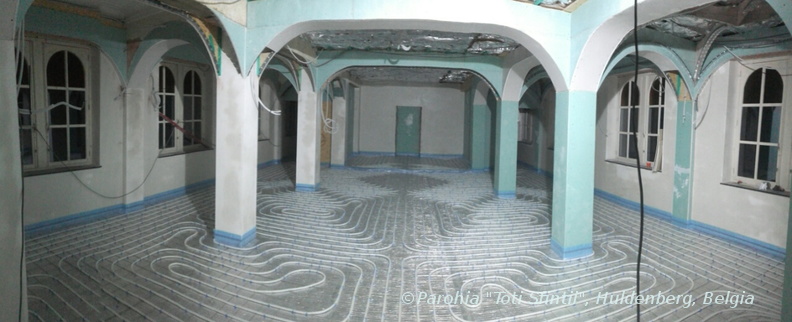
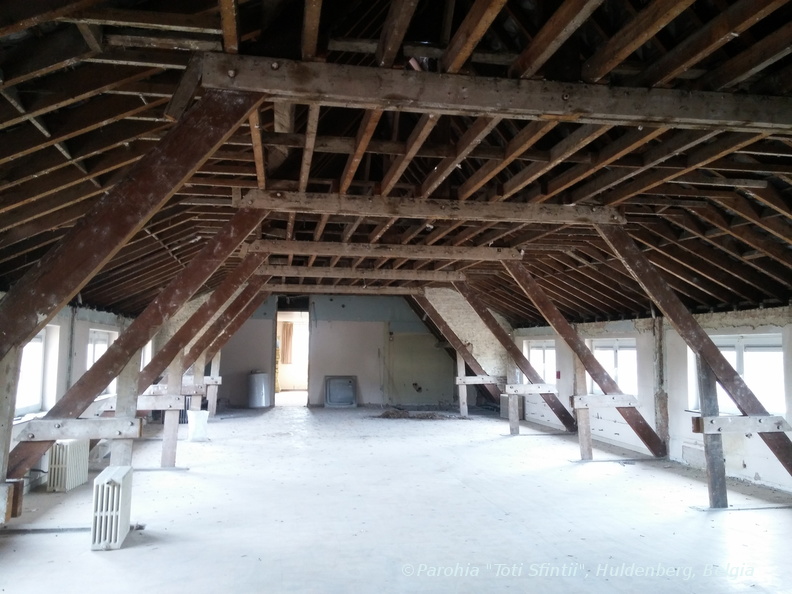
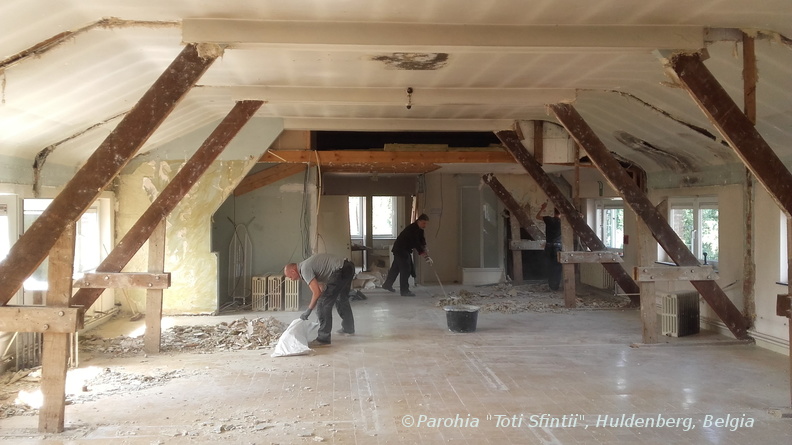
Since then, enthusiasm has filled our hearts more and and we have been working from dawn to night to advance with renovating, arranging and making this new place more beautiful. This project is, however, quite large and it requires serious investment, the most important being that related to heating as well as the roof installation. The roof must be completely changed due to its deplorable condition. The estimated costs are high (for example, just for the roof, we need approximately 40.000 €). But together we can be many and thus the burden is shared. Therefore, I dare to ask for your support: if your eyes are now reading these lines, it means that God’s providence has so ordained: to call upon you, if you wish, to be a founder through any form of engagement, starting with a prayer. Is this a small thing?

You can send us your gift to the parish account:

Account (IBAN): BE03 3631 2661 8584 
BIC/SWIFT: BBRUBEBB 
Beneficiary: ASBL PORTS


The journey continues with the Lord’s help and with yours!


Deeply grateful,

In the name of ‘All Saints’ Parish

Father Ciprian Grădinaru


English

‘My Parish is Essential to Me’ (I)

  • Posted on: 12 September 2017
  • By: delia

Article published in the magazine « The Orthodox Family » no. 97/February 2017

I read in one of Father Sophrony Sakharov’s books that, at a certain moment, a Russian woman living in France wrote to Saint Silouan. She asked him to pray for her so that she would not be forced to work in a city where she could not have a church. She confessed to Saint Silouan that she did not know what hell is, because she had not read much, but she imagined hell to be similar to modern life; full of comfort, only without prayers and without the Church. While reading these lines, I thought that our compatriots in the West live in the hell of faithlessness of those around them. Then I remembered the story that the same Father Sophrony told us often, that of the man who after his death arrived in hell and began to build a church. In the beginning the demons could not believe their eyes; afterwards, having understood that the man was indeed serious and wanted to carry through his plan, they held a meeting amongst themselves and threw him out of hell, sending him to Heaven.

 These things came to mind when my thoughts turned to our friends in Belgium who six years ago founded a monastery, but now they have to make one more time plans to build a new church: they truly desire Heaven! Hence, I called again Father Ciprian Gradinaru once again and we began to analyze their plans together...

- Father, since we have met, it seemed to me that one of your dearest topics for discussion is  the parish. Do you love talking about your parish?

Indeed. I like talking about the parish because, I could say, I love Christ’s church. I have understood that the fundamental reality of the Church is represented by the parish (or the monastic community, if we are referring to monks) of which I am part of, by the ‘local church’, how it is called – namely that community of Christians who gather in a certain place Sunday after Sunday, Liturgy after Liturgy, so that we might partake of the Body and Blood of Christ, uniting ourselves to Him, even becoming ourselves His body.

I cannot live the Church abstractly, I need to be well integrated in my parish, assuming it, understanding the importance of this belonging. When I truly belong to a certain parish, I truly am part of the Orthodox Church. My parish represents the essential expression of the Church and it is identical with all the other local Churches, due to the fact that my parish or my community confesses my Bishop’s faith, and my bishop finds himself in communion of faith with the other bishops of the other local Churches. Therefore, it is very important that the parish to which I belong is authentic.

On the other hand, my parish is vital (if I can express myself in Nichita Stanescu’s manner) to me. I live my life, concretely, first and foremost in relation with my family, my parish and my work. Only then do my friends, neighbours, “coincidental” strangers follow.

Since I have been in Church, as I mentioned during our first discussion in 2013, I was very preocuppied with the way in which I ought to and am able to apply the Gospel to my concrete, everyday life. Hence, if a phenomenon is clear to you, if you understand its principles, you apply it easier. It is simpler to give life to it. I was glad to see that regarding theology, we can even say the theology of family life, there are a variety of books, conferences, positions and guidance of Fathers who could help me to understand, to correct my approach.

Concerning the parish, I have only found a few books, but unfortunately even those used quite a theoretical approach. The most serious and concrete recommendations about how we can live (and the commandment that we must live) life in the parish, I found in the writings of the Holy Apostles Peter and Paul’. Almost two thousand years ago, their pastoral concerns for the newborn parishes (because what else were ‘the Church from Corinth’ or ‘the Church from Priscilla and Aquila’s house’?) ranged from women’s duty to pray with their heads covered to the nature of relations between spiritual brethren. In this way, they wanted to show us that in the spiritual life every detail matters, that there are no insigificant things nor events that happen by chance.

I was and I have been surprised by this situation, by the apparent lack of preoccupation throughout the ages and especially nowadays of the life of the parish, of life in communion.

From my point of view, the parish, along with the family, is that reality where I can particularly meet and live Christ. I dare to believe that the parish is, keeping the right measure, the equivalent of the monastic community for laypersons. Just as it is difficult for a monk to be without his community, the parish needs to be equally precious for the layperson; he ought to search for the one most appropiate for his spiritual “character”. Once he finds such a parish, the layperson out to strive to make his departures from the parish as rare as possible. In fact, when love and a life in Christ tie him to his parish, the Christian will always yearn to be with his brethren, waiting dearly to find himself with them once again . It may seem like I am speaking of wondrous things what I say to you, but they are merely observations made over time in my parish.

Since I became a priest, I have tried to take into account and to apply the practical guidance that I found in the Acts of the Apostles and in the Epistles, to which I added different advice and principles that I found in the Fathers of monasticism, which I then adapted to the parish life of laymen.

- You keep talking about an “authentic parish”. How do you define it? Are there “non-authentic” parishes?

– This is a delicate question, but a very important one. Through my readings of contemporary theologians (Fr. Sophrony, Fr. Zacharia of Essex Monastery, Archbishop Ierótheos Vlahos, Fr. Gheorghios Metallinós), and from what I have seen around me since I came into the Church, I have learnt that a true parish – a spiritual family – has several features, several functioning principles. The parish has to bear certain fruits.

First of all, a parish must be alive, and Christocentric. Gathering people in the same place (even for the Liturgy!) is not enough, if they do not understand what they are doing, why they come to church. In the diaspora, for example, some people who are Orthodox by baptism, and not by practice, may happen to go to church on Sundays for the simple wish to meet their compatriots. Such a group of people can be called an assembly, but not a Eucharistic assembly, which is one of the definitions of the parish.

Moreover, we know that, for administrative reasons, in Orthodox countries parishes usually overlap with villiges or city districts, but the distance between the administrative reality and the reality of the Church is sometimes immense – in the sense that the parish should be the Body of Christ! And those who, though baptised, do not believe and do not come to church at all or carelessly live in obvious sins, how could they be considered part of this Body?

„A natural, healthy consequence of frequent confession”

– Regarding the Eucharistic assembly: I have seen that in the past twenty years, this question has come up and is being studied from all angles, but not necessarily in good faith: how often should we partake of Holy Communion? Frequently or rarely? I found that the way in which this issue has been addressed has done nothing else but created a new polarization, a new divide within the Church. Some have repeated in an obsessive and exhausting manner that we should take it often, others have jumped from their seats crying, “this is dangerous”! And they became upset with one another. We keep forgetting that this spirit of division, of separation is specific to the devil (as the ethimology of his name shows: “he who divides”). Think about other polarizations that divide those that are in the Church: those for and against the Crete Synaxis, those for and against Fr. Arsenie Boca and so on and so forth.

In our parish, I have not obsessively raised the issue of frequent communion (although I believe this would be very beneficial if one lives a careful spiritual life), but I have continuously called for repentance and frequent confession. After several years, the natural and healthy consequence has been that many parish members long to partake of Holy Communion more often and are saddened when they attend Liturgy and cannot. Of course, in this way, we start living every aspect of our life with attention, with strictness and with a conscience cleansed through repentence and confession. Holy Communion is not an end in itself; it is rather an extremely important element – but not the only one – in this complex healing process within the Church, within the parish.

Thus, we ourselves have understood why the parish is called an Eucharistic community: Holy Communion - the Body and Blood of our Lord is the centerpiece of everything and everything converges towards the longing and the need of the parish members to receive Communion and for the new life which follows from there. When we partake of the Body and Blood of our Lord (after we have prepared ourselves according to our strength), we are somehow bound together in one single element – the Body of Christ. This is how you can receive grace, learn to pray, to live attentively, to constantly strive for the peace which stems from a clean conscience, to bear your neighbour – and if you do not bear him, to repent for this fact, to forgive him and love him. This is the only way to understand what is always said during the Liturgy: “Let us love one another, so that with one mind we may confess the Father, the Son and the Holy Spirit, the Trinity, one in essence and undivided”. Otherwise, this call remains a simple string of words.

For he that belongs to a parish, the period from one Liturgy to another is the time to wage his own battle, to strive to live ascetically, to pray as much as possible, to pay more and more attention to his thoughts, to fight his passions. It is the time to make an effort to put into practice what we have learnt during confessions, homilies and synaxes. And when meet again during Liturgy, every one of us offers all his struggles as a sacrifice to Christ, and they are all shared with his brothers and become, in a way, communion, the Holy Eucharist. In this way, community life (life in communion), truly enriches all of us who bring to church our small effort, since we receive Christ in return, He who mystically offers Himself to all of us.

This is how the need for more and more Liturgies develops, the need to see the others more often, to grow closer to one another, to do everything together; all of this, in a natural way.

„ The conscience of family lies at the foundation of life in the parish”

God, in the Council before all ages, said: “Let Us make man in Our image and likeness” Genesis 1:26. He did not say: “Let Us make men”, He said: “Let Us make man”. In other words, we are all one. This theology should be lived at least as an aspiration, and has no value if left in the abstract. If I do not have the conscience that I am potentially one with my brother, it is clear that I will never become one with him and will never grasp the mystery of the Holy Trinity. Assembly, community, communion – notions often used when we talk about Church – are words containing the radical “one”. This is the target of our race: to become one with my brother and through him, with God. This is the prayer which Christ has raised for us, what He desires for us: for us all to become one, as He and the Father are One According to John 17:11

-  Do you mean that in the parish, we should feel as in our own family?

–  Indeed, one could say that the conscience of family lies at the foundation of life in the parish. It is in the parish where we can live another understanding of the meaning of true kinship, which Christ clearly reveales when someone comes to Him and tells Him: “Your mother and brothers are looking for you”. Christ answers: “Who are my Mother and My brothers? Those who do the will of My Father” Matthew 12:47-49.  In this way, He showed us that the time had come for a new definition of family, in the spirit of the Gospels, and that kinship by blood is no longer so relevant. If we are to follow God’s thought, we realize that it is incumbent upon us to strive to do the will of the Father in order to enter into His family. His family means having the Church as one’s mother and a spiritual priest as a father, a father through which we are reborn in Christ. And we would also need spiritual brothers, in order to become part of a family where we can learn to love, and which can uphold us in order not to be afraid when fighting our enemies at the gates Psalm 126 – the enemies being the devil, the passions.

Father Sophrony writes that nobody can save himself, and that – what a frightening thing! — nobody can be saved by force.

God cannot force our freedom. This means that it is our duty, according to our perseverance and determination, to look for this family, to look for these brothers, for this spiritual father who can bring us to life through rebirth, and to allow ourselves to be born again. And from here we have to start another great ascetic work: that of not believing that it is simply chance or the sócio-historical context that brought us together but that Christ brought us together, and we have to fight to hold on to this relationship.

A lot of faith and steadfastness is needed in order to believe that my parish is the place where God brought me to carry out my fight, where I need to live my repentance, my life and where I need to win my salvation. But only this type of asceticism lived by each parishioner will transform a physical, administrative parish (as I referred above, in the sense of a gathering of people in the same church), into a eucharistic gathering, into a spiritual parish, where the Holy Spirit dwells, where the person learns that he is a member of the Body of Christ, that is his parish. And when a member is cut off from the Body, that member is destined for death.

The family is a gift of God, with which we enter history. This is because it is through a family, from a seed of a man and one of a woman, that God found it fit to bring us into history. And, if born in a favorable context, we can be baptized, we can enter the Church. However, it happens sometimes, as we know several unfortunate cases in history, that the family related by blood impedes its members from reaching Heaven, while the spiritual family is conceived in such a way, cosanctified by Christ in the Gospel, in the theology of the Church, that it can be a trampoline towards Heaven. It can be the place, the environment in which we are born into eternity with Christ

“If you do not want to give of yourself, you will never know what joy is”

What is the biggest challenge lived by a man that wants to integrate himself, to live, to assume such an existence in a parish life?

--Just like in family life, the difficulty lies in the fight to humble yourself and to serve the other. It all starts from identifying myself as the other’s neighbour and from no longer having any expectations that the others to be close to me and help me (Luke 10:25-37), from seeing the other as my brother of which I am unworthy. ‘My brother is my life’, says Saint Silouan. If I want to become like Christ then my continous effort, the thought that I need to cultivate, is that I have to fight to serve my neighbour. When I say ‘serve my neighbour’ I am not thinking of great things, but of the effort of daily “small” deeds.

I say the effort of the small deed because many think that we need to do great and glorious deeds in order to call ourselves true Christians. Instead, I think of those acts that usually fill my heart with joy, looking around me: I am glad when brothers and sisters are helping each other, making each other glad, listening to my request to ‘break’ castes (we all know the temptation of talking to or visiting only those on the same cultural or social level with us), humbling themselves by letting the other be right or giving him priority. I am glad to see that they grieve when they find out of a brother who is in suffering and that they come to me with different solutions to help him - in prayer as well as in deed; I am glad when I see my brothers holding the children of others; taking care of other’s kids for a while, in order to give the family with many children the chance to enjoy the Liturgy, to rest, or simply to solve different housework tasks. All of these ‘small’ and frequent deeds, lived concretely, bring an an attitude of opening towards the other, the enlargening of the heart towards which the Gospel calls us to. I strongly believe that this is the way in which we can hope to end up feeling that we become brothers with those we meet in church. Otherwise, living isolated, selectively cultivating relathionships with some more ‘special’ parishioners, we will remain in a ‘virtual’ Christianity, meaning a non-existant one.

The one who serves others learns how to sacrifice himself. What does sacrificing oneself mean? To give of yourself and to give in general, to understand that absolutely everything that we have is a gift from God. And God’s gift is like the manna given to the Jewish people when they were in the desert. Remember that those who tried to keep reserves found the manna rotten. The same thing happens with us and with all our gifts, be they time, money, strength to work or anything else: they becomes spoiled if we do not activate them by sharing them with the brothers that God gave to us. This is the mystery of love; to know that all that you have is from God, to give from everything you receive and to believe that God will give you back ten or a hundred times more. But if you do not want to give and to give of yourself, you will never find out what joy is.

 ‘A friend is the one who doesn’t judge you”

--And still, I think it difficult to reach such a spiritual measure, under the circumstances in which, by becoming so close to the others in parish life, as you describe it, it is hard to not begin to judge, being confronted with the raw, often discouraginig realities of life, and with the weaknesses of those around us…

-- Of course that frequent meetings with the others, outside the church, have the risk of seeing them more humanly and therefore judging, blaming: ‘Look how he talks’, Look how he eats’, Look how he furnished his house’, Look how he behaves with the wife, children, ’ etc.

With the birth of the Church, on the day of Pentecost, there appeared a new type of human relationship: that of brothers in the Church. Brother in Greek is adelfós, meaning ‘from the same womb’- that of the Church. I dare to say that, in a parish, we must add a new category, that of the spiritual friend, in the beautiful sense in which Antoine de Saint-Exupery once wrote: ‘A friend is the one who doesn’t judge you’. I often think that what causes the most harm in a parish, what prevents the birth of a real parish-family is that we judge each other, we do not spare each other, we envy each other, we blame each other. That is why we need to learn and to make an effort to become friends, meaning not to judge each other so. It is in this way that I speak to my brothers about this important thing: that we must become spiritual friends. It’s a great thing to have a brother, but even greater when that brother is your friend!

Many times, it happens that I find a church, a parish that I like and where I would like to stay. After a while, just like in marriage, without my awareness, before I have the chance to understand the mystery of the things I am living, grace is taken away from me (a grace that kept me in a ‘blind’ type of love) in order for me to start the fight to show my faithfulness towards God’s gift. And what do I do? Instead of fighting the old man that is in me, the slave of passions, I start fighting with others. Sick with pride and full of self-justifications, I start to see the imperfection of others. I start to judge them (even to the depths of depravity, which is gossip) and in this way my heart grows cold and I distance myself from them. But this is the moment I should remember that the time of this life is not the time of judgement. The day in which we meet Christ is the Judgement day. The time of this life is for forgiveness, for reconciliation, for growing close to the other. Every time I see a mistake, or something that rings false, or something ugly in my Spiritual Father, in my neighbour, it is my duty – if I want to become a spiritual son or brother – to cover his imperfection with my own prayer, with my own repentance, with my own fight to forgive him, to accept him, to bear his burden, as Saint Paul urges us.

It is unimaginably important to not judge each other, to bear one another’s weeknesses. I proposed to my brothers a plastic image, a ‘modern parable’, if I may say so, a children game: when one of us makes a small hole in a wax board, another must come quickly and fill it with a small piece of plasticine. The wax board represents our common life, the hole is my sin, my weakness, and the plasticine is your prayer for me when you see that I am weak, when you see that I am wrong.

                                                         (to be continued)


English

Encounters with God: from what I have lived and heard close to my Father and brothers and sisters in Christ (II)

  • Posted on: 8 June 2017
  • By: delia

When man knows himself and has acquired mastery over his own mind, he is like a skilled skier that knows how to elegantly pass through all the temptations that he meets on the way to his target - Christ. 

Notes on fasting  

Why does the Church establish fasting periods before all important feast days, before each important event of the liturgical year? Because that aim to which we all yearn has to be a joyful moment. We all know that happiness, even when it concerns earthly things, can only be obtained through labour. The greater the labour, the greater the joy is as well. All of us who have cheated on exams know that after we passed an exam by cheating we went for a drink in order to relax. Yet, not one of us was too happy. Something inside us was telling us that we were not well. Conversely, if you worked hard, studied hard, passing an exam would bring a great joy that filled your heart. Yet, this is only a pale image of what ought to be the labour that precedes joy in spiritual life. 

English

Do you want to be a fellow-labourer of God?

  • Posted on: 6 January 2017
  • By: delia

Update 27 February 2017:

As we have been announcing over the past while, the Lord has gifted us with the chance to buy our own church.

Thanks to the love, the prayers, and the financial help you have offered, we have succeeded in raising the necessary sum to pay our taxes (to the state and to the notary) at the moment of purchase. Yet the road to converting the building into a church and school is arduous, for in addition to the credit that the parish needs to pay over the next ten years in order to become fully owner, there are important renovations, improvement, and safety works that are necessary in the building. We would rejoice if you would be able to participate in this “noble” founding of a church and school (for historically, only nobles and princes founded both churches and schools :-)), helping us according to your strength, and transmitting our request to others.

IBAN account: BE03 3631 2661 8584
BIC/SWIFT: BBRUBEBB
Beneficiary: PORTS asbl

****

In these seven years since the Lord has created a parish out of all of us – the “All Saints” parish –  we live and experience the Mystery of the Church together, which can make out of strangers, brothers and sisters in Christ.

Our parish first began to take life in spirit, and then in body. From a few scattered meetings in the beginning, and then through thousands of confessions, hundreds of Liturgies and myriads of prayers, the Lord bound our hearts and slowly we became a family in Christ. In this family, we have welcomed all who have felt spiritually close to us, thus enlarging our hearts and expanding the “house” of our souls. Even if great distances, and even oceans, sometimes separate us, we are always close. Even if we see some of you only rarely, prayer for each other makes our hearts mysteriously and unceasingly closer.

Our parish needs to leave the church in Vedrin-Namur, and we have been looking for a church for about a year and a half. The Lord has heard our prayers and has recently granted us a great joy, on the eve of the great Feast of the Nativity of Christ: namely the occasion to purchase our own place. It is a rather spacious building in a village called Huldenberg, near the city of Leuven, where we would be able to continue our prayers and all the activities of parish life and of the Orthodox mission work in the West. Part of a former Catholic monastery, the building would permit the establishment of both the parish, as well as a school for our children. (As many of you already know, a few of the brothers and sisters from the parish created a foundation that inaugurated a private school this autumn. “Saint Silouan” school is based on Christian pedagogy, and desires to be for our children a Christian alternative to the official school system.)

We would rejoice and we would be very grateful if you would be able to help us. “To everything there is a season, and a time to every purpose under the heaven” (Ecclesiastes 3:1). Now is the time for founding for all those that wish it.

God works through people, and I would rejoice if this time, He works through you, our brother, our sister, that is reading these lines.

“To be charitable, we do not need money, but good will”, says Saint John Chrysostom, since the value of charity is not in the amount of what we give, but in the thought with which we give it. We thus assure you of our whole gratitude, promising commemoration in prayer, regardless of the amount of your gift.

The information necessary to make a bank transfer:

IBAN account: BE03 3631 2661 8584
BIC/SWIFT: BBRUBEBB
Beneficiary: PORTS asbl


We ask that you also add a short list of names to be commemorated (living and departed) for the future list of names commemorated as founders and benefactors of our church.

“May He remember every sacrifice of yours, may He give you according to your heart, may He fulfill all your counsel. We will greatly rejoice in your salvation, and in the name of our God we will be magnified. May the Lord fulfill all your petitions. (Psalm 19)

Father Ciprian

English

“Love is the seal of Truth”

  • Posted on: 18 April 2016
  • By: delia

Sermon by Fr. Ciprian Gradinaru to the “All Saints Parish”,
on the Sunday of the Myrrhbearing Women, 26 April 2015,
one week after the dormition in Christ of our Spiritual Father Silouan Osseel

Brothers and sisters in Christ,

As the reading for today’s Divine Liturgy, the Church has chosen the part of Saint Mark's Gospel in which the Angel shows himself to the Myrrhbearing women, to bring them the news of the Resurrection of our Lord Jesus Christ. I will not talk to you about this today, but about another proof of the Resurrection. The Myrrhbearing women went to take care of a dead body and instead, they encountered the Resurrection. We have experienced the same thing a few days ago:we went to keep vigil and bid farewell to a beloved man, and came back reassuredof our own eternity, of the love of our Lord for us all, of the fact that love is as strong as the death (Song of Solomon 8:6),and that in Christ there is no separation. Reassured that in the Church, we can constantly livethat overwhelming moment recalled by today’s Gospel: that death has been beaten!

Last Sunday – the Sunday of St. Thomas – one of the greatest fathers of present timeswent to be with God: Father Silouan from Ghent, who was serving in Eindhoven, in the Netherlands. I sayhe is a great Father because, although not much is known about Orthodoxy in the West, many people have heard about Father Silouan, both here, in Romania, and throughout the Orthodox world. This also because he was the disciple of Archimandrite Sophrony of Essex, the next in line on the list of proposals for sanctification proposed by the Ecumenical Patriarchate. Yet it is not so much these aspects which have made him so well known, but rather his entire life. That is why I would like to tell you some things about Father Silouan.

More than anything else, throughout his entire life, Father Silouan was searching for the Truth. He was a Catholic, trying to penetrate into the depth of the Christianity, but he was not content with the experiences he was living. This led him to prayer, to ask God to bring him to know God. At a certain moment, aftera long quest, and after reading a book about the life of St. Silouan, his thirst forthe Truth led him to meet Father Sophrony, the disciple of St. Silouan, in Essex, England. And at that moment he realized that he found what he had been looking for so many years, that he found the real – the only – Church, andhe decided to become Orthodox.

The first time when he visited our parish – because he came here twice, ashe loved us a lot and served the Divine Liturgy together with us, and also held two valuableconferences – how our faith can be relayed most authentically. It very rarely happens thatpeople get to know our Lord Jesus Christ through an extraordinary revelation. For most of us, thisoccurs instead through spiritual parenthood: faith is passed on from the spiritual father to the son. Iwas saying then that, one day, in search of the Truth, St. Silouan was praying with all his heart, and then Jesus Christ appeared to him alive, replacing the icon in front of which St. Silouan was praying. Christ’s gaze remained in his heart for the rest of his life, and following this brief exchange of piercing gazes, monk Silouan was to become the great Saint Silouan.

Some time later, in the courtyard of “Saint Panteleimon” Monastery on Mount Athos, two other “piercing gazes” met: those of Saint Silouan and of Father Sophrony (Father Sophrony even recalled the exact place where they met for the first time). And Father Sophrony, who himself had already lived the experience of uncreated light and had experienced the grace of God, obtained a different knowledge of spiritual life, and understood things that he didn’t understand before. His life then went in a different direction­. After some years, two other gazes met: Father Sophrony's and Father Silouan's from Eindhoven. After that meeting, the latter was never the same again: hebecame Orthodox, and then a priest, living and nourishing himself from that experience of meeting theman of God, Father Sophrony. This has been seen and felt by all those who have met him. And I say all these things because it is important to remember that all the meetings in one's  life are from  God’s providence, and our work is to make them providential, to let God work through them. We never meet someone out of chance – something like “I’ve been lucky” or “look what a coincidence” – there’s no such thing. It depends on us if we bring Lord into this meeting or not, ifwe are  born again through every person we meet in Christ – either by struggling to preserve  the good things we obtained from him and through him, or by adopting  a Christian attitude towards  theone who lies to us, hurts us or betrays us. Even such meetings with people through whom evil is working can be bearers of the Resurrection in our souls if we live them in God.

“We will pray together”

What was very striking about Father Silouan was the fact that I have never heard him talking about ordinary things, nor of ever referring to himself outside of his relationship with Christ.  He had  in his heart a lot of love and understanding for people, a lot of repentancefor himself, and was also  very firm regarding any straying  from Truth and Love. He knew how to humble himself to a lower place than anyone, but he also knew how to strike his fist on the table if need be.  He always offered repentance for his own life, and he always knew how to push you towards Heaven. And all this because Christ was alive in him. I have this conviction that he had the gift of unceasing prayer, the prayer of the heart – this was his dearest prayer. I say this based on the testimonies of two people who have met him.

One of the testimonies  is from a priest who, when he  served once together with the Father, felt his heartstarting to “burn”, and his heart started saying the prayer “Lord, Jesus Christ, have mercy on me!” by itself, continuously and with no effort. And another testimony, truly worth believing: afriend, when he was not Orthodox yet, was very lost, and his soul was very ill.   Hearing about Father Silouan, he went to meet him and to ask for his help. The Father told him he has to pray, and hereplied: “Father, I am as if made of stone, I cannot do anything anymore, I cannot pray.” Then, Father tookhis hand and said: “We will pray together.” And starting that day the man was resurrected -  he prays andall those who know him bear witness  that he emanates prayer. It is Christ’s work through our Father Silouan, who inspired in him the prayer of the heart. Someone was telling me how he askedthis person: “What are you doing when you cannot pray?” and he answered with a terrified look:“How could I not pray?” He could not imagine life without prayer, therefore he answered terrified:“How could I not pray?” And this was the consequence of meeting Fr. Silouan, who made him understand that, without prayer, although apparently alive we are dead spiritually; although our bodies are present in the church, we are nowhere if we don't pray; although'members' of the Church and observing formal traditions, if we don't pray with the desperation and the consciousness that without Christ we will be in hell, we won't find an exit, nor hope for salvation desperately, the dwelling of Christ in our hearts. And this cannot be achieved without prayer.

Fr. Rafail Noica used to say, referring to Fr. Sophrony, that he is one of the last Philokalic Fathers. I dare now say that Fr. Silouan is also among these last Philokalic Fathers: so many beautiful and meaningful words did I hear from him, so many sayings moved my heart. These words were not drawn from books, but inspired by his experience and the life he himself lived! When he heard confessions, for instance, he started with a personal prayer to Christ, in which heplaced himself below all of Creation and from there he started his own confession and helped thespiritual son to acknowledge the position he was in by saying: “Think deeply, it's just you and me andChrist in eternity, nothing and nobody matters, not even the things from the past. It is from now onthat we are starting”. With this attitude, he helped you not to slip into what we are ofteninclined to look for during confession – some psychological comfort or 'magical' solution to ourproblems (in the sense that our father confessor should give us 'a key' to solve our problem,without much effort and struggle on our side )­ and thus fooling ourselves terribly, all the while tiring our spiritual fathers, “stealing” their time, and failing to grow spiritually.  If it seems tous that years go by in vain, without being healed of our passions, let us try to find out first of all –before justifying ourselves and seeking all kind of explanations for our sins, accusing the others:the confessor, the brethren, Christ Himself – if we know how to make a good confession. Let us dare to ask our confessors, let us ask God.

Through confession, Father Silouan helped us to live out the theories we were reading about in books, namely that confession is not the place where we empty our bags full of sins so that afterwards we can continue with our lives as normal (and commit other sins), but it is rather the place wherewe go to be healed, to remove from our path anything that separates us from Christ and from our neighbors, and to find out God’s will in all the important aspects of our lives. Father Silouan’s attitude during confession helped you achieve this kind of consciousness. Actually, he would not hide himself at all; during confession he would continuously say: ‚Lord, Jesus Christ, have mercy upon me!’. You would say what you had to say, he would pray and if he hadany word or announcement from God, he would say what came to him, and if not, he let you leave. But youwould leave truly free – through his prayer as an intermediary of reconciliation between you and God, and you would really feel healing taking place within your heart.

For us (I speak about those in our parish) Father Silouan was a prophet, since many times heuncovered God’s will. Many of the good things that we live together here – I speak for the parish­-  aredue to Father’s announcements, due to his prayers. Every time I was facing a hardship or every time we did not know how to proceed with a situation or another, I went and asked for a word from the Lord through Father Silouan and I always left  with the certitude that the word received was from God. Because ‚the thing came to light’ (what Saint Siluan used to say) or because sometimes he would contradict his own experience (for 25 years he was a parish priest in Eindhoven, but he would sometimes give me a different piece of advice than that which he applied in his own parish). Through this it was evident that he was healed of his own mind, of his own experience, of this temptation to speak from his mind and that he would always seek wisdom from Above.

Here is a beautiful story, inspired straight from the Philokalia, that someone shared with me. A beautiful word inspired from the life of the Holy Fathers that someone dear shared with me. He met Father Silouan at one point, and he was preoccupied with the familiar problem, “I am unmarried. What to do? Become a monk or to try to establish a family?’Father Silouan answered to him in an entirely unexpected, shocking manner: ‚Say the prayer of the heart and master it, and this will help you to distinguish the image of God sealed within your heart; then it will not matter what you choose’. This is indeed the essence and if I understand this, the social form in which I will live is a lot less relevant: I will put my life into God’s hands; He will arrange things and show me the path to my salvation.We can have a successful family, with ‚accomplished’ children and all the classical recipe of social happiness, but our unfulfilled heart still craving eternity. We can be in a monastery­, puppets dressed in black, failing to fulfill existence, if we do not understand the essence of monastic life. Whether we are married, whether we live alone in the world, whether we are monastics, ­ our struggleis to discover, to work the image of God put within us in the day of our making and to yearn toreach the likeness e of the One Who has made us. Without this struggle, without living an authentic spiritual life in the Church, in obedience, with vigilance, we have no chance of any realhappiness: neither here on earth, nor there in the Kingdom of Heaven. This was Father Silouan. He did not have a manual with notes from what he had read I-don't-know-where, nor would he say “let me tell you what I've been reading lately”, but he always had a word born out of prayer. This understanding thatwithout prayer, without Christ, we can do nothing (John 15:4), helped him to build together with his wife, Matushka Oda, a beautiful family, but in particular helped him to build one of themost beautiful parishes that I have ever met – the one in Eindhoven, which he founded in 1990. As one brother from this parish told me, Father Silouan‘s love for the members of his parish was unimaginable. Christ's love was alive, it was visible in him; he would seem to rejoice at your presence in church in particular. This was felt by every parishioner, regardless of their nationality or of their spiritual state. Through his love, Father could join people together. As he often liked to say, one was under the impression that it was Pentecost every Sunday in the Orthodox church from Eindhoven: there werepeople of seven different nationalities (Dutch, Romanian, Belgian, American, English, Russian, Greek and Armenian). Nevertheless, the message of Christ’s love was one and it could be understood by everyone.

„The quality of your relationships with those around you is determined by the quality of your elationship with God”, Father Silouan used to say, urging us to offer repentance for ourselves and prayer for others, as toolsfor goodwill and understanding among the brethren of the Church. He would always urge the parishioners not to let differences of nationality, culture, or education separate them, nor distance them, but to use these differences in order to add value and beauty to the fraternal bond between them. He would helpthem to understand the problems that arose as being opportunities of healing oneself, of growing in love, of seeing the image of Christ, a living icon, in the “other”, an icon that people have to strive to learn to love. You cannot reach such a state  unless you understand that you have to respect your brother’s freedom, as the LordHimself respects it.

The attitude to which he urged his parishioners was not different from that which he himself had towards co-celebrant priests whenever any temptation or any tension wouldarise between them: he would struggle for a quick peace, he would pray for them, he would humble himself, he would repent for what was said or done; as one of these co-celebrant priests had told me, he had a wonderful power to forgive’. Then I asked him: is this not an evidence of the Holy Spirit dwelling in his heart? Is this not a fulfillment of the word of the Gospel, when Christ breathed on the disciples and said to them: ‚Receive the Holy Spirit, to whom you forgive their sins, they shall be forgiven and to whom you retain, they shall be retained’? In addition, when it was necessary, Father Silouan asked for the prayers of the parishioners, because for him the parish was a large family, where parents can and must share the problems that arise with their older children. Proceeding in this way, Father Silouan dispelled the idea commonly met in the Church- according to which the priests must always pretend that all always goes well, that we liveangelically, in a continuous flotation, that between us there are only smiles and flowers...I do not know who is the father of this strange idea­ that even at the cost of lying we should pretend that all is well even when it is not, because otherwise the parishioners will easily fall into judgmental thinking. Father Silouan repeated many times that priests are also imperfect people in their struggle against demons and against the passions and that they must be strengthened through the prayers of those to whom they pastor. He used to often say that ‚love is the seal of Truth’, showing that love is the criterion whichwe should use to find out if our ascetic effort pleases God, if our life is lived in the Truth, to find out whether our ascetic effort is not heretic, according to the word of Father Rafail. Speaking with Father Zacharias from Essex about Father Silouan, he told me that he embodied the definition of what a real priest should be like: a man who burns with love for God and for the people. At one point, diseases began to come over him. When I met him, about five years ago, aclose friend of his asked me to pray for him, as he was very ill and dying (for the umpteenth time!). With the passing of time, getting to know Father Silouan­ but in particular now, when hisperfection has come about, I often recall the words of Saint Paul who says to the Philippians: ‚For to me, to live is Christ and to die is gain. But if I am to live on in the flesh this will mean fruitful labour for me and I do not know which to choose. But I am hard­ pressed from bothdirections having the desire to depart and be with Christ, for that is very much better, yet toremain on in the flesh is more necessary for your sake’. (Philippians 1:21-24).

I am convinced that the Lord decided that in his last few years that Father Silouan would keep living despite of a long  string of illnesses, each more serious than the other, and despite many operations, all for thebenefit of those around him. Before dying, Father Sophrony had told his close spiritual son: ‚I can go to God, I finished what I had to say to Him, I have nothing else to tell Him’. I consider that Father Silouan could also have said this a few years ago, however he remained on earth to continue healing others and to win more people for Christ. Two weeks ago, on the third day of Easter, Father felt sick and had to go to the hospital. His health condition had deteriorated rapidly and Friday evening he went into a coma. By Saturday afternoon­, he had not moved for 24 hours, and the doctors were saying the end was near, so his eldest son, who was keeping me informed about Father’s condition, called me to go and bid him farewell. When I entered the salon, they told Father (who was in a coma) that I have arrived and he flinched at the news. I went and spoke to him in whisper, but the devices to which he was connected sensed the Father’s love and began to go off (Matushka told me that this would normally happen when Father would become emotional); we all wept, we prayed together for a while, while I held his hand, saying the Jesus prayer as he had taught us. Afterwards I asked him: ‘Father, do you want me to read a prayer to you? In French? Or in Romanian?’ Father nodded his head slightly as a form of agreement andthe family told me: ‘Read in Romanian’! Then I asked him: ‘Would you like to receive the Communion? I brought you the Holy Communion.' Father, the one who was in a coma, the one who have not been moving for so much time, in thecondition he was, with his eyes closed, made an effort to sit up. His children came immediately and helped him and Father managed to do something, which I, as a healthy person, do notthink I would have been capable of: despite the three, four tubes he had in his mouth, he lifted a corner of his mouth so that he could receive the Eucharist. After he swallowed it, the devices became quiet and Father felt asleep, tired from the tension with which he lived his last meeting with Christ in the Communion. There was no more place for words – and anyway they were no longer necessary.  Time began to flow again and I left, mindful of Elder Joseph’s words when he received the Holy Communion for the last time: ‚nourishment for eternal life.’ I believe that all of us who were witnesses to what happened left the place with this same thought. (I told you all of these in order to remind you that in the final hours beforedeath, until the soul does not separate from the body, there is still a whole person in there and it isnot only a motionless body; the coma is just an appearance. Do not be fooled by this appearance, do not discuss nonsense or administrative matters near a person who is struggling between life and death,but talk to him, pray for him, with him, because a person who is in coma can hear you very well; I tell you this with certitude, since God gave me this chance to be witness to this many times as a priest so thatI would be able to be fully convinced that the one who is in coma knows, hears and sees everything happening around him.On Sunday he waited until the family came to visit, because in that hospital the visiting hours were very strict. He waited for his beloved ones, they prayed for half an hour together and afterwards he slowly, tenderly, went to the Lord Whom he loved so much. He had confirmed the Resurrection to his children. One of them, that had certain doubts regarding Christ’s Resurrection, later told me that from the very moment of his father’s death, all of his doubts ceased; he was very impressed by how death which is lived rightly brings us to God instead of separating us, as unfortunately happens so often. Father spent the night before the funeral in the church and there were several people from our parish as well as from his family who kept a vigil and prayed together with him. In Romanian, we have the word ‚vigil’, but you all know what unfortunately happens at  most Christian vigils – they are, in fact, more pagan rather than Christian..I tell you this because our grandparents and parents begin to go to Heaven and people are going to die around us and we are going to die too, one by one. Hence, it is important to know that what occured at Father Silouan's beside should occur at the bedside of any Christian:  people should read continously, near the coffin of the deceased, either from the psalms or from the New Testament, and we should pray for the one who goes to meet God. Everyone who spent the night with Father had felt that state of grace and peace, the samestate that we experience on the night of Resurrection. Therefore, when in the morning, one of Father’sboys thanked those who stayed overnight to keep vigil, I couldn't help but smile, and so, I said to him: ‚For meit was a great privilege!’ Father Silouan was so precious to us, he had such a busy schedule, he was elderly and sick and therefore all our meetings were limited. Finally, that night I had time totalk at length to my Father. It is important to not forget that the soul is there, although the only thing remaining of our dearly departed that we can physically see is the dead body, the cadaver, the image of death.  Man is immortal. Perhaps you recall the story when someone came to Avva Evagrius, a hermit of the first Christian centuries, and said: ‚ Avva,your father died!’ What did he answer?: ‚You say blasphemy! My father is immortal’. If we had this faith and this conviction, we would live the days between death and burial feeling comforted, feeling strong,  in a more Christian like manner, to the benefit ofthe one who is leaving as well as for our own sake.  It is important to learn to speak in silence which is far beyond words, to the one who is leaving, using the love that connects us to him as a bridge, a means of intercession, to God. . Most great people have talked about the silence that is full of words, of sense... The Holy Fathers, who have tasted of Heaven, say that silence is the language of the age to come. We ought to learn to be quiet while speaking, to be quiet while praying at the bedside of the sick or atthe bedside of the one who has just departed from this earth.

As I said when Madam Andrée went to the Lord, it is through the lives of those well-pleasing to God that we must understand that our salvation is at hand, that holiness is a relevant and timely theme, that there is no context – historical, political, or otherwise – which impede us from being saved, from being holy.  Our choices define us, they formus, they lead us to Heaven or not. After the last Liturgy that I celebrated together with Father (before the funeral), a brother wanted to comfort me, telling me that we must not to be sad more than necessary because Father left us a rich legacy. Since then, these words keep ringing in my heart, it sustains and nourishes me. Indeed, Father Silouan has given us so much: he has given us everything.

English

Liturgical Programme 

  • Posted on: 26 February 2016
  • By: delia

Saturday 
18:00 Vespers 
19:00 Confessions 

Sunday 
8:30 Matins 
10:00 Divine Liturgy 
12:30 Lunch (please bring something to eat for your own family
13:30  
    for adults: "Sinaxa" - discussion on spiritual matters; "Philocalia" - presentation of a spiritual book 
    for children: Playing time for your heart 

For mi-week services, the announcements will be made at Church. 

English

About us

  • Posted on: 16 September 2015
  • By: delia

Interview with our Father in Christ Ciprian, published by “The Orthodox Family Magazine”, no. 53 (June 2013).

“Christ is in our Midst!”

            Father, many people know that the first Romanian Monastery in the Benelux area (where several Romanian sisters have lived for more than a year now) has been founded through the sacrifice and the spiritual and material support of many God-loving people from around the world, but especially from a group of Christians that have gathered around you in a true community. Isn’t it a bit strange for such a lively parish to function around a “monastery church”? How did this start?

           This is a longer story, and, up to a point, a personal one. From my perspective, it started a long time ago. Ever since I can remember, I was given a gift: the conscience of the fact that invisible ties connect me with all people. I felt that something beyond appearances, relationships and words links me to them. Having lived my childhood in the countryside has probably played an important role in this regard, since the ties that link people there are stronger, more profound.  Furthermore, I had a passion for chess and I loved the motto of the International Chess Federation, “gens una sumus” (”We are one people”). In the same spirit, years afterwards, I had found joy in John Donne’s words, who was quoted by Hemmingway in the title of his book, “For Whom the Bell Tolls?”, as saying the same thing: “any man’s death diminishes me, because I am involved in mankind, and therefore never send to know for whom the bell tolls; it tolls for thee”.

However, I was feeling all of this on a superficial level, since at that time I was not a believer, and I could not imagine that living with “strangers” as with your own family could be ever achieved.

When God brought me in the Church, I started to read the New Testament and the writings of the Church Fathers in a different light. Among the many things that filled me with joy as I was reading them, I found the idea I mentioned before. This idea “floats” throughout the New Testament, but is very clearly expressed in our Saviour’s prayer from the Gospel of Saint John, “that all may be one, as You, Father, are in Me and I in You; that they also may be one in Us.” (John 17:21), or in the Acts of the Apostles: “the heart and soul of those who believed were one” (Acts, 4:32). And I said to myself: the Church is the place where I can fulfill my longing for many to live together as one single family, as one single man!

            I then started to search for how to live this. However, at the beginning, I do not know why, God kept away from me the places where Christians were striving to live this way. Although I visited many churches and monasteries throughout the country, I could not find, almost anywhere, not only such a state of being as I was looking for, but not even the effort of conveying or seeking one. And I did not mean that as a normality of church life, but as an ideal, at the very least. Maybe I was not looking in the right place, although I was travelling thousands of kilometers searching for that way of community living or feeling. Everywhere I went, I heard sermons and teachings about how to go to Church, how to fast, how to do good deeds, how to pray, etc; in other words, only personal, or individual, undertakings, of Christian life. I was full of sorrow and disappointment, and I felt that we were missing what was essential. What a difference in the spiritual state of the Christian community described in the Acts of the Apostles and of those I was visiting. I recall that at some point, I even confessed my sadness to my spiritual father at the time. We were in a “serious monastery”, with good, ascetic rules and I felt that not even there could I find such a state, nor even a search for it among the brothers. My spiritual father’s answer to my inquiry was mind-blowing to me, something like, “don’t you have anything else to do?

            And so, for a while, I was very distressed. I was home, but I was surrounded by strangers. I was assured of the holiness of the Church, of the fact that salvation is only in Christ, but I could not understand how external forms of devotion (observing the formal rules of attending church, as well keeping all the fasts, etc), can save man. I could not see how the struggle to fulfill Christ’s commandments and acquire Christian virtues has become an end in itself rather than the Way towards the real goal – that of receiving the Holy Spirit and the fruits He yields: fraternal love, kindness, etc. I could not envision Heaven, which I saw from the start as Love and communion: after focusing, my whole life, on the relationship with my God, with my spiritual father, on my prayer, my Liturgy and, maybe, on my ties with a few brothers (a few brothers, carefully chosen, based on all “quality standards of spiritual life”), how could I begin, once passing into eternity, to begin loving my fellow brothers?

But the good God tended to my wandering and sent me good spiritual fathers, and then gifted me with Father Sophrony of Essex, a man of God, whose writings changed my life to the greatest possible extent. What a great light, what a great joy! I read all his books, I nurtured myself from them and I regained hope that those things I was dreaming about were possible on Earth. He speaks a lot about the Adamic conscience (we are all brothers in Adam, our father), the importance of the principle of personhood in the spiritual life, and in his “Spiritual Sermons”, he offers the community he was shepherding a lot of practical guidance on how a Christian community should live, based on the evangelic principles. And I dare to say that he has enriched the “lines” of living together in Christ which Apostle Paul suggests in his letters through his own experience of a sanctified life. A life that was crucified between burning in love for God and serving his brothers. 

Not long after that, God gave me a good spiritual father around whom a monastic community was forming, and that made me joyful once again. I was glad that such an experience was possible in reality, not just in books. Then I found out – and I keep finding out! – that there are many more such parishes and communities in the country and in the world, and I was even happier.

After some more years, I arrived in Belgium, where I was ordained a priest. I prayed with increasing boldness for God to grant me to meet people who could receive and understand my thoughts, so that we could start to live a small part of those things which Christ wishes so much to sweeten us with, even now in our current life – as a “holy hook” to make us willing to work even more for the unshakable Kingdom. And God did not idle in giving me such brothers and sisters, one by one. People who desired more, who quickly understood the words of Saint Seraphim of Sarov, that the aim of life is acquiring the Holy Spirit. That every form of life and expression in Church (prayers, fasting, iconography, etc) must be circumscribed to this aim and not become an end in itself. That nothing is relative in the Church. That you do not come to Church to find a certain degree of comfort, but to find the truth about yourself and about God – premises one cannot do without – in order to start your spiritual life in “spirit and in Truth”. That a spiritual father is not necessarily the priest you confess to several times, but the one you assume and that assumes you in return; that is, you feel he suffers the pain of your birth in Christ, according to Saint Paul’s words. That without a life of unceasing vigilance, struggle, frequent confession and communion, there is little chance for us to grow spiritually and even less to be saved. That Sunday Christianity is not possible, in the sense that we meet some people which in time, perhaps we get to know by name, next to whom we pray church, and then “God bless” - “God bless” at the end of the service, “see you next Sunday” and it’s over.

Forgive me my long storytelling. What I essentially wanted to say is that I am fully convinced that God gives man what he wants, if it is useful for him and if the man is sincere and constant in his search. 

May I interrupt you for a second: how did we get to the point of living only “Sunday Christianity” ?

If the lives of many Christians are spiritually exhausted, if so many people who go to Church are lonely and sad (and not by their own choice), I believe the responsibility lies equally with the shepherd, who should convey to his brothers a true image of life in Christ - in union and in the struggle of love - as with his own parishioners, who often do not want and do not strive for more (I remember the popular saying: "each parish receives the priest it deserves"). I dare to compare such impersonal parishes, made of "small churches" (small groups of people inter-connected as a result of their social environment or interests of any kind), to “idiorrhythmic” monasteries, where the only common interests are administrative ones. I do not cease to draw the attention of my brothers and sisters in Christ to the fact that, if we lose the spirit of brotherhood, we will also become yet another "idiorrhythmic parish", where everyone looks for his/her own problems and where, although we nicely say, before the Creed, that "Christ is in our midst", oftentimes we lie. If Christ were indeed in our midst, the ties between us would be different.

How can we acquire this spirit of brotherhood you are talking about?

I can tell you how we are fighting to cultivate it, to earn it.

As I was saying before, based on Church Fathers' words that he who prays only when he is saying his prayers, is not actually praying, we would understand that our prayer must not be limited to our mornings and our evenings, but we must fight so that our prayer becomes a permanent state of being, even our own breathing. Similarly, I think that a simple "Sunday" relationship with the other members of the parish is not a true, spiritual relationship. And for this, even since the moment our community was founded (when there were only a few people around me who I was confessing), my preoccupation was to encourage my brothers to get to know each other, to become closer to one another. At that time, I was a priest serving at the largest parish in Belgium, where a lot of people were coming from throughout the country. A community as I envisioned it was hard to form in such conditions. Little by little, some of us started to meet in our homes - for a house blessing, for a service of the Paraklesis, for a cup of tea, but especially in order to come together and bond as a family. From there, things evolved in a natural, beautiful way. The brothers started to become closer and to become fond of each other. As their number was growing rapidly, it was more and more difficult to gather in one single house, and we decided to look for a church and set up a parish in order to live out what we wished for. We quickly found a former Catholic church for sale, but we could not buy it. We were sad in the moment, but then we understood that, as He always does, God had prepared something better for us.

In Romania, almost every weekend I would go to "recharge" myself at a monastery. There was no such place in Belgium, where I had been living for several years, and I was craving one. And so, as soon as I was ordained a priest, I asked for the blessing of our Metropolitan to start looking for such a place, so that we could buy it in the hope that, at some point, we could have a monastic community as well. I found several such places, but every time we encountered obstacles and could not finalize anything. However, in January 2011, as soon as I received a negative answer for the church we were trying to buy, I got a call from a Belgian Orthodox friend, who was aware of my search for a monastery, to see if I was still interested in finding a space for a church. The property of a former community of Catholic nuns of Byzantine rite was for sale. The Mother of God granted us a miracle then, because the person in charge of the sale had already contacted the representatives of all the Orthodox communities in Belgium and none was interested. Then the monastery was almost sold to a real estate promoter, but an (apparent) administrative impediment did not allow him to close the sale.  "By chance", that person called our family friend, who called me, and we went to see the monastery.

A surreal discussion took place at that moment. I was negotiating on behalf of the Romanian community in Belgium, although I was convinced of the support of only some dozens of people, those close to me. It was a sort of madness, one that continued afterwards. For when I presented the project - and especially the price - to my Metropolitan and to several of my fellow priests from Romanian parishes in Belgium, I was told it was too much, that we could not receive financial support from the Church structures, given the financial constraints we face in the West. We fully understood this fact, but we could hardly accept it, given our feverish enthusiasm. We then had to resist the temptation that a few friends from our midst associate and buy the former monastery as individuals, in order to donate it afterwards to a parish and set up lodgings in the part of the building that was housing the former nuns' rooms. We all felt that this place had a potential for much more and I kept asking my Metropolitan only to come and see the place and give me the blessing to launch a fundraising campaign in all Belgian parishes. When he came, His Eminence became so enthusiastic about what he saw that he decided to support us, asking the other parishes to help, since we could not provide the whole amount just by ourselves. We had to pay quite a substantial advance. It was difficult, given the short period of time we had to gather that amount, but finally - through the prayers of our Metropolitan and many of our brothers – as well as through the sacrificial generosity of many brothers from Belgium and throughout the world, we raised the funds we needed. We received great help from the Mother of God and Saint John the Russian, one of the “friends” of our Community, to whom we prayed, promising to dedicate the monastery to him if he would help us buy it. And, yet another miracle! The first vigil in the monastery’s church took place on the very feast day of Saint John, on 27 May 2011!

Afterwards, once the community began serving in the monastery (right after it was bought, in May 2011 – the nuns only started to come half a year later), we tried to lay down in this place as well, the foundation which I find essential for any community: the spirit of brotherhood in Christ.

Among the first important decisions we took to this end, in addition to praying, was to share meals together on Sundays, after the Liturgy. The Divine Liturgy is the Mystical Supper, and the community “agape” is the spiritual meal. Communion with and in Christ. In concrete terms, several groups of families have organized themselves, each preparing the luncheon every few weeks for about 100 to 150 people - the average number of those attending the Sunday Liturgy. There is such an atmosphere of joy, which I trust will remain. People no longer dash home to eat, they take their time to talk to each other, to get to know each other, to enrich themselves, to be joyful.

After the agape meal, while a group of volunteers takes care of the children and tries to convey to them certain teachings from the Christian faith (in a playful way, as I excluded from the start the notion of "Sunday school" or "catechism", which, in principle, make everyone shiver, both the little ones and the adults), I proposed to those able and willing to stay for a "course for spiritual survival", following Fr. Seraphim Rose's idea. We freely discuss different spiritual topics, and I present books that are important for every Christian, since sermons and confession are not enough to form a Christian mindset for those attending church. Moreover, we thus lower the risks - inherent in the diaspora - of turning church going into a pious habit aimed, first and foremost, at socializing or at getting patriotic thrills (what I mean to say is that I have noticed in the West a tendency of going to Church in order to meet people with whom one does not have time to meet during the week, or to encounter fellow countrymen).

Do you think the Divine Liturgy and the agape meal are enough as expressions of spiritual communion?

Of course not. There are other important things.

Many members of our parish resemble each other also through their love for the Saints of the communist prisons. I think they can be extraordinary models for us. Radu Gyr, the great poet in shackles, said a terrible thing: "It was in prisons that we learnt “live” what being Christian truly means." The drama of the life and death of many of those imprisoned has been consumed between these two words: "live" and "truly". And the stake of our salvation, the passing from the moral to the spiritual stage of Christian life, lies in these two nuances.

What I find impressive, among other things, in those who gave witness “behind bars”, is their spirit of sacrifice. And I am glad at the general understanding that reigns in our community that only through sacrifice can we make a good start, and that nothing is possible without sacrifice. There are many things I could say I have seen and lived with my brothers, and these things have brought me joy and humbled me, but I will not mention them here so as not to disturb anyone's spiritual state.

Secondly, as I told you from the outset, I wanted us to start coming closer together spiritually. I proposed to my brothers a common prayer for unity, the so-called "11 o'clock prayer". About ten years ago, I had proposed to several friends in Christ, spread in various parts of the world, to meet in prayer at 23:00, Romanian time. "Meeting in prayer" is a perhaps a lofty expression, but in essence, I had in mind our Saviour's words: "where two or three are gathered together in My name, I am there in the midst of them" (Matthew 18:20). Since in the meantime, many of us have married and it has become more difficult to observe a certain time, I have suggested "11 o'clock" as a generic time, only to enable us to come together every evening before God, wherever one finds himself. Let's say the Jesus prayer a few times ("Lord Jesus Christ, have mercy upon me!"), as well as the prayer for unity around the spiritual father, written by Father Sophrony of Essex, where every member of our community is mentioned. This prayer contains the essence of the concept of unity: "make us to be truly a brotherhood, living in one heart, one will, one love, as one man, after Your advice from before ages to Adam, the first born."

Whenever one of us, or a member of one of our families, encounters a difficulty, I have asked the others to let me know so that we can all undertake a canon of prayer (in general, we each sign up for a few hours of prayer for several nights in a row, and as a community, we end up ceaselessly praying the Psalms during those nights). God has already brought us joy several times through many miracles, in order to strengthen our faith.

Following the idea of the community prayer, and inspired by what I have read from the Saints of the prisons about their struggle to pray even in conditions of incarceration, I proposed to my community to launch, at the start of each month, a "vigil lamp of prayer". Concretely, for as many nights as we can cover, those of us who are able to choose one hour to pray on certain nights – we pray for ourselves and our families, for the community, for the world – thus trying to keep prayer alive continuously for several consecutive nights. When someone finishes his/her prayer and goes back to sleep, another one wakes up and lights up the "lamp", thus trying not to extinguish the chain of prayer for even a single minute. This has brought us a lot of joy and closeness in Christ, since those nights are full of grace and one feels responsible for his community and for all Christian brothers sleeping at that hour of the night, since perhaps he is the only one standing before the Lord at that time, in the name of all.

And last but not least: in order to guard ourselves against the danger of individual and community selfishness (since, if we only think about ourselves, no matter how many “we” would be, we would still remain caught into a certain form of selfishness), and in order to “enlarge our hearts” (after Saint Paul’s expression), I have started to send to my brothers in Christ, the messages I receive from many friends from around the world, with requests for prayers for people in great need to be remembered at a certain moment, so that they can all pray for them. I find the chance we are given to be extraordinary – the chance to become labourers with God in fulfilling His will in someone’s life – thus starting to cultivate in us that “Adamic conscience” I was talking about in the beginning. Moreover, we also realize how capricious our own complaining usually is, compared to the suffering of other people.

Father, to summarize: what does it mean to be a parish?

Personally, I fully share the vision of His Eminence Metropolitan Hierotheos Vlahos. Any man distanced from God is a sick man spiritually speaking. The parish is a “spiritual hospital”, whose creation has one purpose – the spiritual healing of its members, the blessing and the deification (“theosis”) of those who form the parish. Any other purpose – national, political, church-related or social in nature – would degrade the notion of “parish”. And unfortunately, there are many such counter-examples in the West as well. Although we have become used to the image of parishes as “gatherings of people going to the same church” (“idiorrhythmic”, as I call them), this issue is more serious than it looks. For any priest, any parish with such a vision deprives its members of the chance for a right understanding of what Church can offer them. They are thus confined to a grave illusion that keeps the Christian far away from God.

The parish is a big family gathered around a spiritual father, centered on Christ and living a life in the Church. The faithful strive to engage more profoundly in the life of the parish by getting closer to one another through Christ, by fighting to heal their passions through the fulfillment of commandments and obedience to their spiritual father. And the Father-priest should be the ”physician” of this hospital.

It is the duty of the spiritual father to imprint the thinking of the Church to the willing members of the parish, “to offer” God to them in a right, Orthodox understanding. To help them see that there is no such thing as a non-dogmatic, non-ecclesiological and non-ascetic Christianity, as Father Sophrony is quoted to have expressed. To help them shape a Christian conscience, a universal conscience, through which everyone becomes aware of the fact that both the good deeds he performs, as well as the sins he commits, have repercussions for his spiritual family, his family after the flesh, and, finally, for the entire world.

How do you see the future of your community?

I do not project one. What is important is that we have a present. I am profoundly grateful to my Metropolitan and to my brothers and sisters amongst which God has placed me and through which He has granted me all of this. I am fully aware that it is not for our merits, but for our many weaknesses, that God bestows so many gifts on us.

My concern is to live today without sin. And if everything ended tomorrow, for one reason or another, I would be left with great joy: that it is possible to live, in this life, this closeness, this communion with my brothers in Christ. That what I have dreamt about so ardently years ago, can be achieved. That everything can be done in Christ our Lord, He who strengthens us. Everything - in Christ!

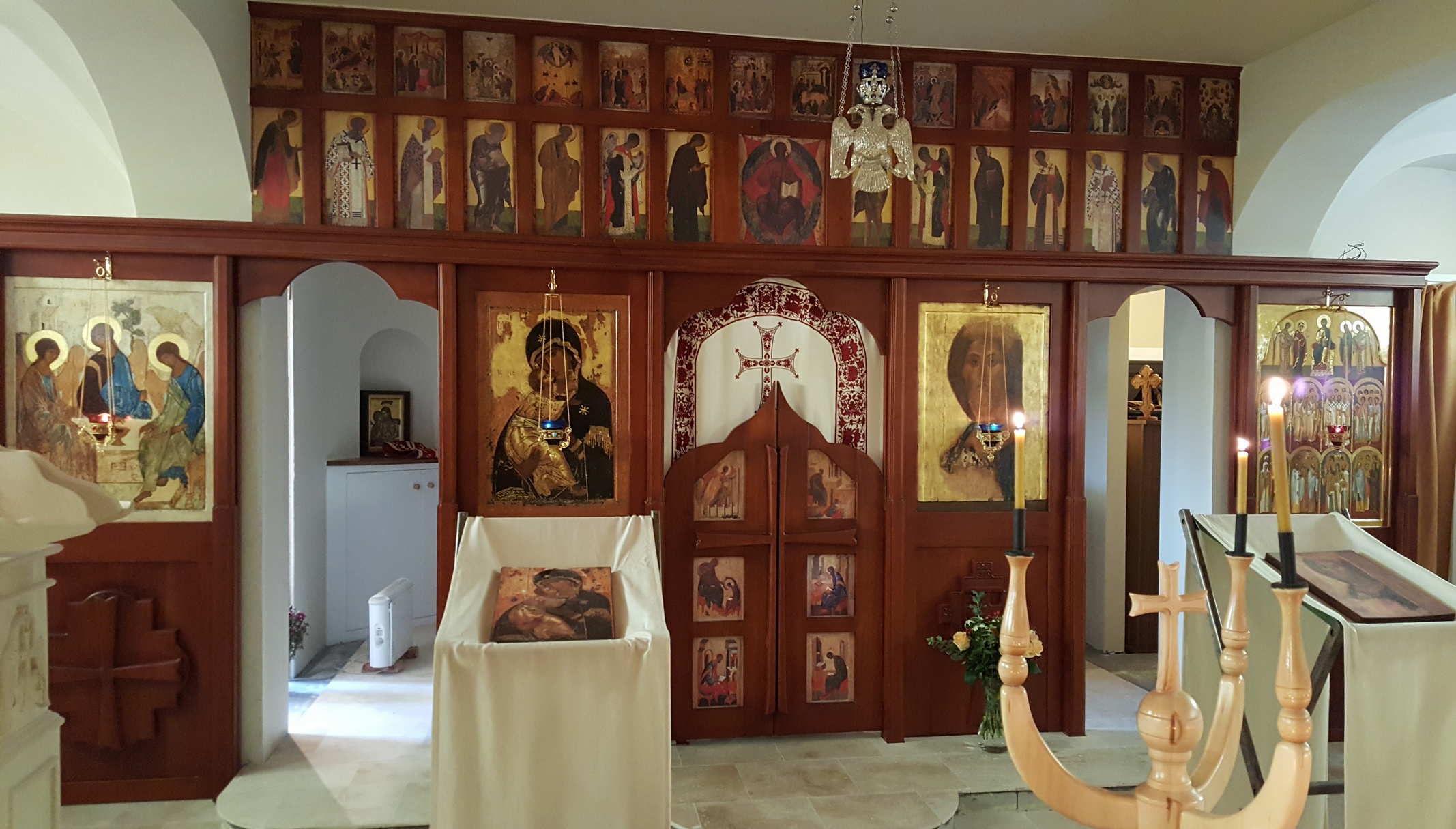
English
Tags: 

On the feast of St. John the Russian (+27 May), our protector

  • Posted on: 15 November 2016
  • By: delia

Starting from what we know from the life of Saint John the Russian and the special relationship our parish has with him, I would like to share with you a few thoughts about St. John.

1. First, I would like to recall Saint John’s gift to us, those who gather here [at the church in Namur], for all our services. Every year, on May 27th, we celebrate Saint John as one of our great protectors, as the one who, as it became obvious for us, granted us this place. And what he did for us is no small thing!

For those who do not know, I would like to recall the fact that, when we started to look for a church for our parish (around 2010), we took Saint John the Russian, Saint Nektarios, Saint Ephraim the Newly Revealed, and Saint Nicholas as companions in our search. And we prayed to them to help us find a church we could buy.

At some point, in January 2011, we found out that a former Catholic monastery – the one in whose church we serve today – would be for sale. We all started to pray to our dear saints. My heart was leaning towards Saint John the Russian, whom I asked for help in order to buy that property, if God was willing, while promising him that at least one of the feasts of the church would be dedicated to him. Moreover, with a boldness bordering on insolence (a boldness which I would not have today), I asked him to convince me that this place was his gift, by arranging everything in such a way so that the first vigil held in this church be on his feast day, May 27th. Everything happened around January that year. Humanly speaking, this seemed impossible, but I kept remembering the encouragement of Father Rafail Noica, to ask for God’s help especially in those things that seem impossible.

Indeed, everything was arranged in such a way that on May 23rd we received the keys of the church. We also had time to clean the place, to build an Altar to our Lord and tidy the surroundings. And Saint John the Russian decided to give us another gift: on May 26th, he gave our bishops the idea to hold their annual meeting in Brussels. In this way, we were able to invite them on the evening of May 26th, to sanctify this place and bless our beginning.  Afterwards, we remained there and continued our first night vigil in this church, dedicated to Saint John the Russian, thus serving our first Saint Liturgy.


I have thus understood that, in a very obvious way, Saint John the Russian helped us with both the documents, as well as raising the money necessary. He did what he did and did not let us down, and gave us this church. Now, it is our turn not to let Saint John down J, to “harass” him with our prayers to always take care of us. This is what the saints want, what the Most Holy Mother of God wants: to constantly ask for their help. In this way, our ties with them will become stronger and stronger, our mind will be seized more and more with the heavenly things, and we will develop the reflex that, both in peacetime and in wartime, we raise our mind to Christ and His saints.

2. We have also learned another very important thing from this concrete help from Saint John. At the beginning, the thought of buying the former Catholic monastery was met with mistrust and disapproval by almost all the people I knew: - my superiors and my colleagues -  the asking sum was large, and I could only count on the financial support of a handful of close people (I had only about 30-40 spiritual children at that moment). However, to all the ironies and “negative encouragements” of those who did not believe that we could ever be able to buy this place, I responded with a story about Gheronda Joseph: one day, an acquaintance of his passed by the courtyard of his cell, where Gheronda was with a couple of his spiritual sons. That acquaintance chaffed a little bit at him, asking him: “These are your disciples, Joseph?”. But Gheronda peacefully replied: “Yes, indeed, they are. But as poor as they look to you, in a few years, they will change the face of the Holy Mountain!”. I was smiling as I was making this comparison, but what I meant to say was that for God, the thought always precedes the deed, the accomplishment (see Genesis). If a thought is well-pleasing to God, He will provide the right means and the right people to accomplish it. And this was proven right, because, by the prayers and enthusiasm of a small number of my spiritual children, such a state of spirit emerged that it rapidly spread beyond the borders of Belgium, touching many hearts, that then transformed into concrete help in the founding of this monastery and of our parish.

3. Through his life, Saint John gives us an extremely important lesson about freedom. In the Church, we have learned that, in order for one’s life to be meaningful, man has to learn to live freely. The experience of Saint John (and of the saints from the communist prisons), shows us that true liberty is the one of the Spirit, the freedom of a man who is not a slave of any inner determination (that is, of any passion). Because from the outside, he lived as a slave to a pagan throughout the years during which he sanctified his life. In a certain way, we also live through what Saint John had to experience, in a world where our external freedoms are limited, even to the point of their nullification; we are led by people without God, who impose on us the way we should think and act, who mock at and persecute our faith. Saint John’s greatest concern was to continuously pray to God to grant him grace in order to struggle to cleanse himself of passions, and to endure all the troubles and mockery from those around him.

4. Saint John’s solution is essential, for he shows us another way of witnessing to Christ apart from the bleeding of martyrdom – that of remaining a Christian in all our daily choices and attitudes, both internal and external, and of receiving everything as coming from the hand of God, by His tolerance. What a battle against thoughts he must have had – as he was a man like us! Maybe not necessarily against his Turkish masters, but certainly the enemy suggested him thoughts such as “When will the Lord save me from this slavery?”, “Why did I have to be taken prisoner?”, “Why did this happen to me?”, “How long do I have to stay in this filth, in this stable, where is God’s righteousness? I am faithful, I pray, I fast, I go to church, and these unfaithful and unbearable Turks make a mock of myself instead of God punishing them”, and so on and so forth.

5. Afterwards, when the Muslim masters became milder, understanding that the blessing and abundance bestowed on their families had come through their slave John, they offered him the option to move out from the stable he had been living with the animals into a more honourable room. However, Saint John withstood three major temptations:
- the temptation of pride (he could have said to himself : “at last, they realised that their living has improved by my prayers ; I deserve their reward");
- the temptation of the psychological consolation (he refused to accept the joy of the human reward of his Turkish master, while preferring to remain in the stable until his death, thus entering the joy of his Lord – see Mathew 25:21);
- the temptation of a comfortable life (a great temptation for the Orthodox Christian, but especially for us in the diaspora, one we face every time we anchor ourselves on earth and not in heaven, sacrificing even our children on the altar of our own comfort and ease);

This is the attitude we should follow as well, the people of ‘today’, we who are so tormented by thoughts, attacks and challenges from within and outside the Church. We should fight with our thoughts, we should offer repentance and we should struggle to be cleansed of our passions and to remain in obedience to the Church. We should fighting to not sin, to not judge, and to become part of a community where we have a spiritual father and where we strive to become one with the others, according to the commandment of our Lord.

6. Saint John can also be of great help to those who, due to various circumstances, cannot be part of an authentic parish or of a certain community, and are tempted to give up the fight, to give up prayer for himself and for the world. Nothing is lost with God – not a single whisper, not a single tear, not a single labour for the benefit of the Church – nothing is in vain. For our Saint, his model was Christ and his saints, who toiled the land of the Church without waiting for confirmations, consolation or human gratitude. We see this in the life of Christ, we read about it in the epistles of the Saint Apostle Paul: he, who could have given his life for the others, was betrayed and disappointed by people so many times, but he never abandoned the struggle of proclaiming Christ to the world. And we can see in Saint Silouan as well; he who, for instance, after many hours of service and work, strived to write a few thoughts every day about God’s love, having one single desire: that at least one soul might benefit from reading them. And for all this, God, not people, has glorified him.

This is how Saint John lived and this is how we ought to live, driven by this thought: “I do this for Christ! Neither for you, nor for them or for myself for that matter; but for Christ!”. And everything will be easier.

Fr. Ciprian

English

Talk with Fr. Nikolai (Essex) - Friday 13 November

  • Posted on: 20 October 2015
  • By: delia

We invite you to a talk with

 Fr Nikolai Sakharov
from "Saint John the Baptist" Monastery in Maldon, Essex

on

christian marriage


Friday 13 November 2015, 6.30 PM


Maison Notre-Dame du Chant d’Oiseau
Avenue des Franciscains, 3a
1150 Bruxelles


Hieromonk Nikolai Sakharov is the grand nephew of Archimandrite Sophrony Sakharov (1896-1993), an outstanding Christian ascetic, monk and mystic of the 20th century. He is a member of the Monastery of Saint John the Baptist, Essex, United Kingdom.

The talk is specially addressed to young people in search of Christ and Christian marriage.
The talk is going to take place in English. Translation into Romanian will be provided.


English

Talk with Fr. Nikolai (Essex) - 12 November

  • Posted on: 20 October 2015
  • By: delia

We invite you to a talk with

 father Nikolai Sakharov
from "Saint John the Baptist" Monastery in Maldon, Essex

on

Fr. Sofrony's teaching


Thursday 12 November 2015, 7 PM


Salle des Familles de Saint Marc
30, Rue de la Cure de Saint Marc
5003 Saint Marc, Namur


Hieromonk Nikolai Sakharov is the author of "I love, therefore I am: The Theological Legacy of Archimandrite Sophrony", which offers an exposition of the theology of Archimandrite Sophrony Sakharov (1896-1993), an outstanding Christian ascetic, monk and mystic of the 20th century. This exposition conveys the message that Christianity is not just academic discipline, but reality, life itself.

Hieromonk Nikolai Sakharov holds a Ph.D in Theology from Oxford University and is the grand nephew of Archimandrite Sophrony. He is a member of the Monastery of Saint John the Baptist, Essex, United Kingdom.

The talk is going to take place in English.Translation into Romanian will be provided.

English

Pages